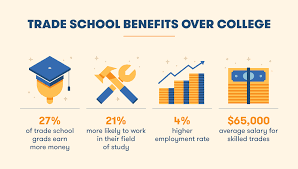
When it comes to planning your future, one of the biggest decisions is choosing the right educational path. Traditionally, college has been considered the default route for ambitious students, promising prestige, networking opportunities, and higher earning potential. However, trade schools—institutions that focus on vocational training—have emerged as a strong alternative, offering practical skills that lead directly to in-demand jobs. The question that often arises is: which pays more in the long run, trade school or college? Let’s break it down.
Understanding Trade Schools
Trade schools, also known as vocational or technical schools, provide specialized training in specific fields such as plumbing, welding, electrical work, cosmetology, automotive repair, and healthcare support. The main advantage of trade schools is their focus on practical skills that are immediately applicable in the workforce. Programs typically last 6 months to 2 years, which is significantly shorter than the standard 4-year college degree.
Trade schools often appeal to students looking for a faster entry into the workforce. Graduates don’t carry as much student debt, and many trade school programs have partnerships with companies that hire students directly after completion. This means that students can start earning sooner, sometimes at competitive wages, compared to their peers in college who are still studying.
Understanding College Education
College or university education is more traditional and often emphasizes broad knowledge, critical thinking, and career flexibility. Degrees can range from associate’s degrees (2 years) to bachelor’s degrees (4 years), with some students pursuing advanced degrees for specialized professions. College can open doors to careers in business, law, medicine, technology, education, and more.
While college degrees generally cost more and take longer to complete, they are associated with higher lifetime earning potential, especially for fields such as engineering, computer science, finance, and healthcare. College graduates often enjoy more career mobility and opportunities for advancement, but they may also start their careers later and carry substantial student loan debt.
Earnings Comparison
When comparing salaries between trade school graduates and college graduates, it’s important to consider both starting salary and lifetime earnings.
- Starting Salary: Many trade school graduates can earn impressive starting salaries. For example, electricians, plumbers, and HVAC technicians can start around $40,000 to $60,000 per year, depending on location and experience. Some highly specialized trades, like commercial pilots or dental hygienists, can start even higher. In contrast, many college graduates in fields such as education, social work, or liberal arts may start with salaries ranging from $35,000 to $50,000 per year.
- Lifetime Earnings: Over a 40-year career, college graduates generally earn more than trade school graduates on average. According to the U.S. Bureau of Labor Statistics, the median annual income for someone with a bachelor’s degree is approximately $75,000, while someone with a vocational certification earns around $55,000. However, this gap can be smaller—or even reversed—if a trade school graduate enters a high-demand field.
Debt and Financial Considerations
A major factor influencing overall earnings is student debt. College graduates often take on significant loans to finance their education, sometimes exceeding $30,000 to $50,000. Trade school programs, being shorter and more targeted, usually cost less—often under $15,000. Less debt means graduates can start saving, investing, and building wealth sooner, which can have a substantial impact on long-term financial stability.
Additionally, trade school graduates may have the option to start their own businesses sooner, such as opening a plumbing or electrical company, which can dramatically increase earning potential. Entrepreneurship is less common immediately after college, where many graduates start in lower-paying entry-level positions before climbing the corporate ladder.
Job Market Demand
Another critical factor is demand. Skilled trades are experiencing labor shortages in many countries. Jobs such as electricians, welders, and HVAC technicians are in high demand, and this demand is projected to grow, driving wages higher. College graduates, depending on their major, may face a more competitive job market, especially in fields like journalism, humanities, or arts, where supply often exceeds demand.
Flexibility and Career Growth
College offers greater flexibility for career changes. If you earn a degree in a field that becomes obsolete or oversaturated, you can pivot to a new career more easily than in a trade. Many careers in technology, finance, and healthcare require a degree as a minimum qualification, and higher education can facilitate promotions into management and executive roles.
Trade school graduates, while earning well early, may find career growth limited if they stay in hands-on roles. However, additional certifications or starting a business can expand opportunities significantly.
Conclusion: It Depends on Your Goals
So, which pays more: trade school or college? The answer is: it depends.
If your goal is fast entry into the workforce with minimal debt, trade school can be highly lucrative, especially in skilled trades with high demand. For example, a certified electrician or dental hygienist can earn a solid income immediately, with the potential for entrepreneurship.
If your goal is long-term earning potential and career flexibility, college is likely the better investment. Degrees in high-paying fields such as engineering, IT, and healthcare can lead to substantial lifetime earnings and opportunities for career advancement.
Ultimately, the decision should not be based solely on potential salary. Consider your interests, strengths, risk tolerance, and the type of work that will make you satisfied. Both paths have the potential to lead to financial success, but the right choice depends on your individual goals and priorities.
Key Takeaways:
- Trade schools are faster, cheaper, and lead to practical skills with immediate earning potential.
- College takes longer, costs more, but offers higher lifetime earnings and career flexibility.
- Student debt and job market demand are critical factors in overall financial outcomes.
- Your personal goals, interests, and willingness to continue learning should guide your decision.
In today’s economy, there is no one-size-fits-all answer. Both trade schools and colleges have the potential to pay off financially—success comes from choosing a path that aligns with your skills, goals, and lifestyle.