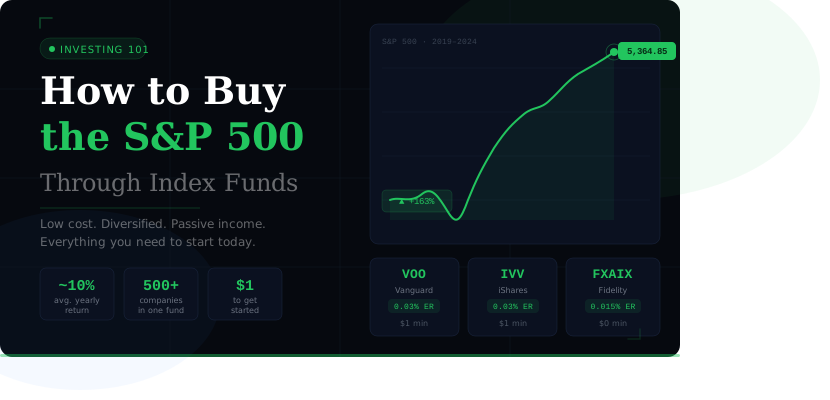
Investing in the S&P 500 is one of the most popular ways to build long-term wealth. The index tracks 500 of the largest publicly traded companies in the United States, including giants like Apple, Microsoft, and Amazon. Because it represents a broad slice of the U.S. economy, many investors use it as a core part of their portfolio.
But here’s a key detail: you cannot buy the S&P 500 directly. An index is simply a benchmark. What you can buy are index funds or exchange-traded funds (ETFs) that track the performance of the index.
Understand Your Two Main Options
Before investing, you’ll usually choose between an index mutual fund or an ETF.
An S&P 500 index mutual fund allows you to invest money directly with a fund provider, often with automatic contributions. This can be convenient for long-term investors who want a hands-off approach.
An S&P 500 ETF trades on a stock exchange like a regular stock. You can buy and sell it during market hours, and many ETFs have very low fees.
Popular examples include:
- Vanguard’s VOO
- BlackRock’s IVV
- State Street Global Advisors’s SPY
These funds all track the same index, but may differ slightly in fees, structure, and trading features.
Step 1: Open a Brokerage Account
To buy an S&P 500 index fund, you’ll need an investment account with a brokerage.
You can open an account with providers such as:
- Fidelity Investments
- Charles Schwab
- Vanguard
- E*TRADE
When choosing a broker, consider:
- Account minimums
- Trading fees or commissions
- Fractional share investing
- Research tools
- Ease of use
- Access to retirement accounts
Many brokers now allow you to start investing with very little money, sometimes as low as $1 through fractional shares.
Step 2: Fund Your Account
Once your account is open, transfer money into it. This is usually done through:
- Bank transfer
- Debit transfer
- Wire transfer
- Recurring automated deposits
A recurring deposit can be powerful. Investing a fixed amount every month creates consistency and supports dollar-cost averaging, which means buying whether prices are high or low instead of trying to time the market.
Step 3: Choose Your S&P 500 Fund
Now compare funds before buying.
Look at:
Expense Ratio
This is the annual fee charged by the fund. Even small differences matter over time. A 0.03% fee can leave you with more money decades later than a higher-cost alternative.
Tracking Accuracy
Check how closely the fund follows the S&P 500.
Liquidity
For ETFs, higher trading volume can mean easier buying and selling.
Fund Provider Reputation
Large established firms often offer strong reliability and lower costs.
For many beginners, low-cost broad-market funds like VOO or IVV are common starting points.
Step 4: Place Your Order
Once you choose a fund, enter its ticker symbol in your brokerage account.
For example:
- VOO
- IVV
- SPY
Then choose how many shares, or fractional shares, you want to buy.
If buying an ETF, you may place:
Market Order
Buys at the current market price.
Limit Order
Sets the maximum price you are willing to pay.
Beginners often use market orders for simplicity, though limit orders can provide more price control.
Step 5: Hold for the Long Term
This may be the most important step.
The S&P 500 has historically experienced short-term volatility, but many investors use it as a long-term strategy because of its broad diversification and growth potential.
Trying to jump in and out based on headlines can turn investing into financial pinball. Long-term discipline often matters more than perfect timing.
Consider:
- Reinvesting dividends
- Continuing monthly contributions
- Reviewing your portfolio annually
- Staying invested during market downturns
Time in the market often matters more than timing the market.
How Much Money Do You Need?
You may need far less than you think.
If your broker offers fractional shares, you might start with $10, $50, or $100.
Some investors begin with a lump sum.
Others build wealth steadily through monthly investing. Both approaches can work.
Common Mistakes to Avoid
- Ignoring Fees
- High expense ratios can quietly reduce long-term returns.
- Trying to Time the Market
- Waiting for the “perfect moment” can keep you on the sidelines.
- Panic Selling
- Market drops are normal. Selling in fear can lock in losses.
- Not Diversifying Beyond One Strategy
While the S&P 500 is diversified, some investors later add international funds or bonds.
Final Thoughts
Buying an S&P 500 index fund is surprisingly straightforward:
1. Open a brokerage account
2. Fund the account
3. Choose a low-cost index fund or ETF
4. Buy shares
5. Hold and keep investing
It may not feel dramatic. No flashing lights. No cinematic trading-floor thunder. Just quiet compounding, the wealth machine that often whispers while it works.
For many investors, that simplicity is the point.